
Published 18 August 2026
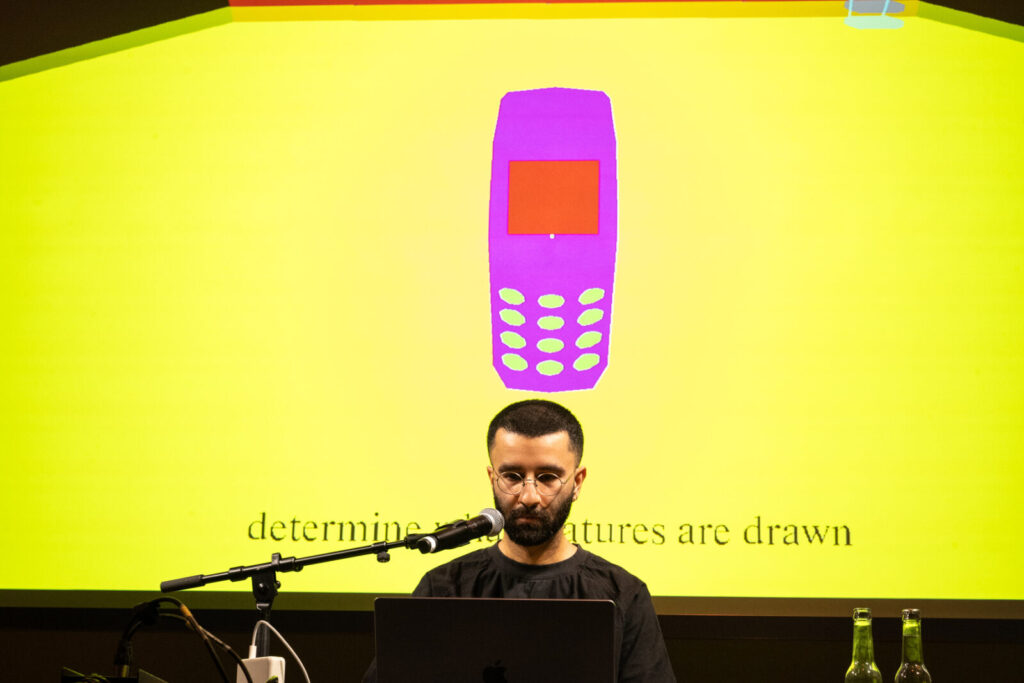
The Compression Zone was one of our favourite works at this year’s transmediale. Shaheer Tarar’s performance moved between live reading, videogame, autobiography and essay. The result felt playful, strange and unusually fresh.
At the centre of the work is the idea of compression. Tarar begins with an almost abstract proposition: to perceive something is, in a sense, to swallow it. But nothing can ever be swallowed whole. Something is always selected, reduced or lost in the process. Compression becomes a way of thinking about how we encounter images, information and other people.
This gradually acquires a more personal dimension. Tarar moves through memories of growing up with a computer at home, early encounters with the internet and the desire to reach beyond the immediate world around him. For those who experienced an earlier internet built around downloads, waiting and discovery, these recollections carry a subtle nostalgia.
What stayed with us most was a slight melancholy around communication itself. Connection appears as a continuous attempt to reach something outside oneself while knowing that it can never be complete. Every transmission involves compression; every act of receiving produces another version of what was sent.
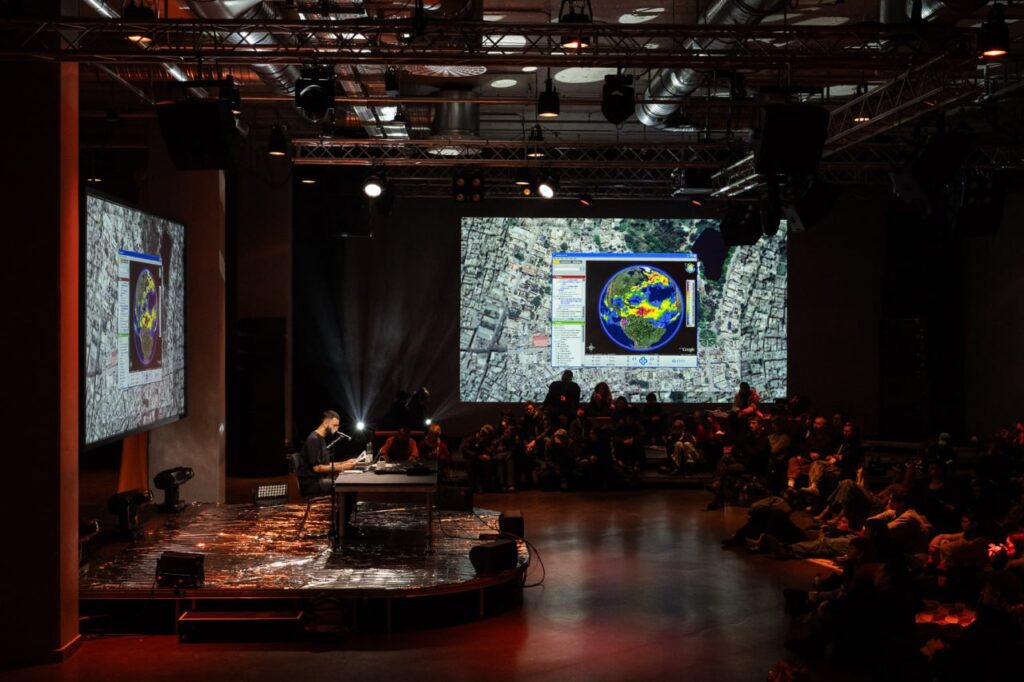
There was also something striking about watching Tarar speak about his childhood relationship with computers while sitting in front of one himself. Across the two-screen installation, biography, interface and performance folded into one another.
The Compression Zone turns research into something that can be inhabited: a space where technical processes, memory and emotion remain compressed together and never fully separable.
It was one of the works that surprised us most at this year’s transmediale, and the starting point for the conversation with Shaheer Tarar that follows.
José: In The Compression Zone, you talk about your family computer and your first encounters with the internet, at a moment when it carried this promise of being a window to the world. Can you tell me a little about that?
Shaheer: Basically, I grew up in Pakistan, in Lahore, and my mom was a computer programmer. Specifically I think she did work around databases, she was a database programmer, at a time when no one in Pakistan even knew what a computer is, let alone have a woman doing this kind of thing, right?
And so because of that, she convinced her dad to get us a computer, and he also didn’t quite understand the importance of it. But we put it, I remember that it was in this really tiny room. It wasn’t this centerpiece, it was in our guest room, it was really far away, we would have to go there to work on it.
But it became this neighborhood attraction, so people from around the neighborhood would come to our home and look at this device, and mainly just want to look at it. They didn’t really know what it could do or why it would one day be important or why it was already really important, maybe, but I quickly became obsessed with it.
And specifically I remember, I think the reason I became obsessed with it is, I mean I loved being on it exploring, but I wanted to show the value of this device to all these people who were coming to see it. And there were two main ways I found to do that.
One was I would go on to Google Earth or whatever the earlier version of that, and I would try to show them their home from a satellite image. And that was really compelling to them because they’d never seen this, the place that they live in, they would have never encountered an aerial image of that ever before that point. And so to see their neighborhood rendered in that way, and to see their home rendered in that way, even if you couldn’t see it quite exactly, but to roughly see the kind of environment it was in.
And then the second one was they would often want to see, if I told them that they could see pictures of anyone, they would want to see pictures of Reema, who was a really popular Pakistani actress at that time. And they would be, “Oh, can you show us a picture of her?” And I would look at pictures of Reema, and they’d be, “Oh, there she is.”
Which is interesting. I think that aspect of the internet of looking for celebrity hasn’t quite gone away, but it’s interesting that that was also one of people’s first impulses when they laid their eyes on this device.
José: That reminds me of something my dad told me. When he was a kid, only one family in the neighborhood had a color TV, so everyone went to their house to watch it. You were, in a way, the house with the computer.
Shaheer: I hadn’t quite reflected that until now, that that was the first moment that they may be seeing this place that they lived in for so long rendered from a completely different perspective. And the fact that I was there for it, to witness it … maybe this is something to kind of extrapolate further.
José: I wanted to ask about the format of The Compression Zone. In a more traditional film language, you might simply record the voiceover. But here your body and voice remain present, live, with all the reactions and variations that come with that. Why was it important for you to perform it this way?
Shaheer: The decision to not have my voice pre-recorded, I think that also has come from, in doing my PhD research, one thing I’ve learned is the importance of the particular chemicals in the brain of the person who’s doing the writing. The work that a lot of these scholars do is never separate from the chemicals in their brain, if that makes sense.
I think I’ve realized the value of the human in research, the idiosyncrasies of the person who’s presenting the work, and I think that has become more acute for me in the AI era where AI tries to kind of normalize all of human thought and human aesthetics and present it to them. It’s kind of the medium aesthetics or the medium thought of human society.
And so I think in that context for me, placing the human in front of people, like this is a human who did this, this is a human who’s saying this, is becoming more important.
José: Everything is so digital that it’s nice to see a human body there. And there’s also a small space for improvisation: the tone or rhythm can change.
Shaheer: The emotions of what I’m saying may be striking me in a particular way in that performance, to move even away from efficiency a bit, to embrace the kind of flaws and idiosyncrasies that come with a human being present.
José: How did you become interested in compression as a concept?
Shaheer: I guess it came from thinking about worldview. So if I can kind of look back on the trajectory of my work and think about what is a question that I’m trying to resolve in them. And this is not something that I set out to do at the beginning, but I think it’s something that I look back and can find the through line to my work, which is: how is a worldview constructed, right?
So we all walk around with a sense of the world, and yet we can only witness with our senses a really small section of it. And we’re quite confident about the worldview that forms based on those geographies of experience, if you will. But how do we come to worldviews that are just as confident about places we’ve never been?
And so I think this was seeded when I first moved from Pakistan to Canada, and it was a really small town that I moved into. I was the only person of color in that entire high school I was in. And other people there had a really confident idea about what Pakistan was like. I don’t think actually anyone there had been to Pakistan. And they had a really confident idea about what this place was like, and this is what I was like as a Pakistani.
And also I had really confident ideas about what Canada was like, but my ideas about what Canada was like were not being challenged because I was in the geography of experience, where I was experiencing this place, and yet their idea of Pakistan was just as confident as their idea of the place that they were physically in.
And I just think that’s really fascinating to explore, how does the world picture form in our mind?
And I think that’s kind of where I started thinking about compression, is that all forms of representation, so they’re probably hearing about Pakistan in the news, and the news is made up of a set of images, a set of texts, and a set of people who are conveying that, and they are valuing certain things about that place, right? Which are important to whatever story that they’re telling, or whatever media narrative might be prevalent at the moment, whatever state narrative might be prevalent at the moment, but also what is getting attention.
And so that place, Pakistan, is getting compressed through all these filters and being conveyed to these people, and then it is reforming into that place in these people’s minds.
So starting from compression as a really technical process which happens to all these images, but then compression as even kind of expanding into a metaphor of this process that must happen for information to travel from one place to another so we may understand the world.
José: Even to communicate with another person, in some way we have to compress an image of that person and their culture. But there’s always a loss in that process. An MP3, for example, isn’t the same as a high-quality audio file. What does that loss mean when we’re talking about our perception of people or places?
Shaheer: One thing I still want to say is that the point of these works is actually for us to learn to live with compression and to understand that our understanding of the world is mediated. But also to recognize that it is necessary to compress the world for us to be able to live in it.
And so this process of compression is not just limited to media artifacts, but it’s also a thing that we do, even physically in the world, right? We do this to other people. We can’t understand a whole person in their complexity, and so we compress them down to certain qualities.
You meet a person once, and you will remember a particular quality. And that’s not maybe their most important quality, but it’s somewhere in between them and what you value in a person, right?
But then the thing to recognize is that along that compressed format is where that person or that place or that geography becomes actionable.
So an example that I would give is, my MA research was around the cartographies that were produced of South Asia when the partition was happening. And so when the British Empire was leaving South Asia, and when India was being partitioned into two colonies, or sorry, two nation states, Pakistan and India.
And at that time there was a lot of map making being done of that place where people were reducing this vast place to the things about that place that they value.
And what the British Army did is they, when they had first started colonizing South Asia, they produced these maps of South Asia that reduced South Asia to symbols that were important to British rule. So rails and particular types of trees and particular crops, where the rivers are. They reduced this vast place down to just a set of symbols that were important for British rule.
And the only sign of social life that they put in these maps were religious centers. So they drew mosques, they drew mandirs, they drew gurdwaras, they drew Buddhist temples. And even though religion was an important part of social life in South Asia, it was not the most important. There was other kinds of social organization.
And yet the British found religion to be the most important because at that time in Europe, religion was. There was all sorts of religious strife, including Protestants and Catholics. So religion was probably the most important belief marker in Europe at the time, and they found that in South Asia.
So then what happened is when partition happened, so Radcliffe, who was the lawyer who was given the task to do the partitioning, he didn’t have time to actually visit the areas he was partitioning. So he was like, “Give me, what can I use to do this partitioning?” And he found these maps that the British Army had made where the most important marker was religion.
And so he made the borders between India and Pakistan based on these symbols that were what was important to British rule. And thus these two countries were made in the name of religion or separating people by religion.
And so that’s, I guess that’s what I mean, is that a place becomes actionable and governable through these artifacts of compression. But then when actions are made through those artifacts, something of that compression lands and collides with the complex reality of that place. So not that it remakes the place completely in the image of the compressed artifact, but then something of it collides with the place.
José: What’s fascinating is that compression then intervenes in reality and changes its material conditions.
Shaheer: And you can see it from, it’s one of the two borders you can see from space now. So the border between Pakistan and India, and the other one is the border between North and South Korea. Those are the only two borders that you can see from space. And the Pakistan-India one was made using this artifact of compression.
José: This makes me think about something I worked on at university. At the time, I imagined embassies almost as obsolete buildings: digitalization seemed to be making everything fluid, borders were supposedly disappearing. But suddenly walls, trenches and physical borders have returned with enormous political force. There’s almost a new medieval imaginary: the castle, the wall, the moat with crocodiles. Why do you think we’re seeing this return to the physical border? Is it a reaction to that earlier promise of fluidity, or was the disappearance of borders always an illusion?
Shaheer: I mean, I guess there’s a host of obviously material conditions which make people seek and retreat into identities, right? But that is a whole arena of study. What’s more interesting to me about it is the media infrastructures that accompany that.
And so I guess I would say that, instead of having less, we’re kind of arriving at a world where we can get borders wherever we want them, right?
So this is something I look at in my PhD thesis where if you go on Google Maps and you look up the border between India and Pakistan, the border is placed in a completely different location relative to which country you access Google Maps from.
So if you’re in India, the border’s in a particular place. If you’re in Pakistan, the border’s in a particular place. And neither of those vectors on Google Maps align with the actual physical border, which as I was saying, you can see from space.
And they’re imposed by law, right? In India it’s illegal to represent the border differently than the state-funded version. And Pakistan’s trying to implement similar kinds of laws.
And so it’s more so that to cater to local nationalisms, the representation of the border can, the border can be placed wherever you want it to be. The world can be presented to you in the way that is most comfortable to you. And I think that’s kind of the transformation.
You can basically get images of the world produced that align with your version of the world. So you can feel that the world aligns with your ideology, your political motives, the border is in the place that you are in.
José: There are a lot of philosophical questions here about perception and communication. What authors have helped you build a kind of map for thinking about these things: borders and how imaginary they can be, but also the images we construct of other people?
Shaheer: The most prominent one probably for me is Lev Manovich’s Database as Symbolic Form. And basically in that essay, he makes the argument that historically, our main container of information has been the linear narrative.
So we tell each other stories that have a clear beginning, middle, and end that we gather around the fire, and then in the novel and in cinema. But the computer stores information in the form of the database, where nothing has a clear beginning, middle, or end, and there can be multiple layers of information for each category of information; it can be rearranged to serve different people.
And I think we see that, right? So we see that in the case of the border that I was just talking about, the India-Pakistan border, is that the border is not this linear construction that both countries understand in the same way. The border is a set of vectors that’s stored in Google’s database, and it’s served to different people depending on where they are and their identity and where they’re located.
Which is not to say, I mean, the border is physically experienced by people who live along it, right? It does physically exist for them. And then they face its violence living around it. But for the people who don’t live along the border, the border is essentially reduced to a set of vectors that can be served up to them depending on the whims of the state.
I think that was one of those texts that, at the right time, fueled all of my thinking.
Another example of this actually is when text messaging or instant messaging first started: we used to start and end conversations. We would be like “Hi,” and then we would sit across the computer, and there was another person on the other end of the computer and we’d have a whole conversation, and it was rude to leave before saying bye. You would say hi, and you would have a conversation, and then you would say bye.
And now we don’t start and end a conversation with one person. We have many conversations ongoing at all times. You look around you and you can’t see the threads of conversation, but there’s a thousand conversations that have never ended, which is also really overwhelming.
José: That makes me think of the comparison between written and oral culture, and this idea that we may be moving towards something almost pre-written again. A book has a beginning and an end, while now everything seems to remain permanently open.
Shaheer: But actually, I guess I would say, just to kind of quickly reflect on that, is that I’ve turned in my recent work to the narrative, to re-invoke the narrative, because I do think stories are important.
I do think there is something: a linear story can hold an audience captive. People kind of wait for what happens next, right?
And I guess maybe coming back to your question of why these nationalist narratives are coming back, I think it’s because people crave stories. They want a linear story, they want a cohesive story that they can tell about themselves and the place they live.
And to live in a database political structure where there’s like, “Okay, well, this thing, the government is doing this thing, but it’s not going to help you, it’s helping these other people,” which we should be okay with, we should be okay with the state helping all sorts of people. But then people are like, “No, this story the state is telling about itself, it doesn’t include me anymore. And what kind of story can I tag on to to resist this database story where the state helps all these people in all these different ways that I can’t understand? And so the state should be built around me and people like me.”
I think maybe there’s kind of like a narrative resistance, where the narrative is making a comeback in forms of religion, in forms of nationalism.
And I think I haven’t quite recognized this tendency until recently in my work, but what I am planning to do is find all these disparate things and weave them into a narrative. The Compression Zone is an attempt to take my PhD research, which is otherwise a bit esoteric, into a narrative, into entertainment, into a story, so we can tell new forms of stories about ourselves. That can still include all sorts of people, right?
José: And narrative itself is also a kind of compression: it makes something understandable by putting a huge amount of information into a story. There was this idea, particularly around the pragmatism of the ’90s, that we were leaving the big stories behind, that we could simply act without these myths or grand narratives. But even the idea that we’ve escaped stories is itself a story. Maybe they’re impossible to escape, and the question is what kinds of stories we construct.
Shaheer: Because I think so much of, I mean, and again, this is outside of my domain of research, but I think a lot of liberal scholars talk about how liberalism, and whatever it’s called now, was built around this idea that there’s all these stories that we tell ourselves about our past that hold us back, that are restrictive, that are oppressive, that make us not cohere.
And so we can rid ourselves of those stories and we can just kind of exist. We get to determine our purpose in the world, that our purpose in the world is not predetermined by a story that other people are telling us.
But I think perhaps it’s a case of, when we’re left to find our own story, it’s hard to build a community around everyone. It’s hard to build a community around everyone finding their own individual purpose and story in the world.
And there’s all sorts of writing done on alienation and isolation. And I think maybe that’s why there’s a retreat to these kind of stories of community, of people finding each other, but in ways that are also exclusionary. So forming a community but at the expense of other communities.
José: That reminds me of René Girard and the idea of the mythical story that unifies a community. He’s become influential in Silicon Valley. There’s something disturbing about understanding these structures and using that knowledge not to question them or make them visible, but potentially as a form of control.
Shaheer: I guess the bottom line is we love a story. We love a story.
José: I remember last time we also talked about your project with the moth. Can you tell me about it?
Shaheer: I guess it’s interesting: that is another way to take something that’s really complicated and turn it into a story.
But basically, I’ve been trying to think about how to make work about AI that is not reactionary in the sense that it doesn’t just react to the existence of this technology, but it says something about the world that it is producing.
One avenue of research recently has been web crawlers. So web crawlers are basically these little pieces of software that autonomously browse the internet, and they basically download information, images, text from the web, and they collect them into databases.
And so web crawlers have existed since the beginning of the web. Google is built on web crawlers, that’s how they know where all these websites are, but they’ve become central to AI because these web crawlers had produced these massive datasets, and then these datasets, which contain the entire internet, were fed into AI models, and that’s kind of what all contemporary AI models are built upon.
And web crawlers, because of that, they’ve become even more common. So about 50% of all internet traffic is now these web crawlers. So I wanted to make work around those.
And then if you look at these crawlers, what does a crawler look like? I mean, it’s a piece of software, it doesn’t really have a morphology. But I was trying to figure out what does a crawler look like so then I can maybe make work around it.
And I went looking in the US patent drawings. These abstract formless entities are assigned a form because lawyers have to just give them an image. So they would draw crawlers as these spiders in patent drawings, so crawlers would be spiders.
So that reminded me of this earlier story from 1947 where there was a Harvard Mark II computer, and at Harvard it was a huge computer, it was the size of a room, and it stopped functioning properly. And so the scientists were working on it, they opened the computer and they found a moth that was stuck inside one of the circuits of the machine.
So they pulled it out and they taped it into their notebook, and they wrote “moth in relay” because it was stuck in a relay. And this is, it’s kind of an apocryphal tale, but this is the first case of debugging, so an actual bug being removed from a computer.
So I kind of connected the two and I was like, what if this moth is the crawler that is crawling the internet?
And so that’s what that piece is. The idea is the moth was never removed from the machine, it’s still stuck in the machine, and instead it’s learned to live amongst all these fiber optic cables and servers and data centers and hyperlinks.
And so it autonomously navigates the web, looking for a way to escape, but it can never quite find a way out.
And it’s an exciting piece for me because it runs live, so it has access to the internet and it kind of browses the internet live. And it’s just as distractible as we are in a way that I didn’t expect it to be, so it looks for a way out of the data center, but then it gets distracted by all these links. It starts clicking on all these different links that are not relevant to its purpose in life, right?
Which was a really nice kind of surprise in the program.
I guess a lot of my recent work is thinking about crawlers and following crawlers, and the story that we learn about the internet and the internet infrastructure by following a crawler.
Photos: Mirka Pflüger, 2026.