
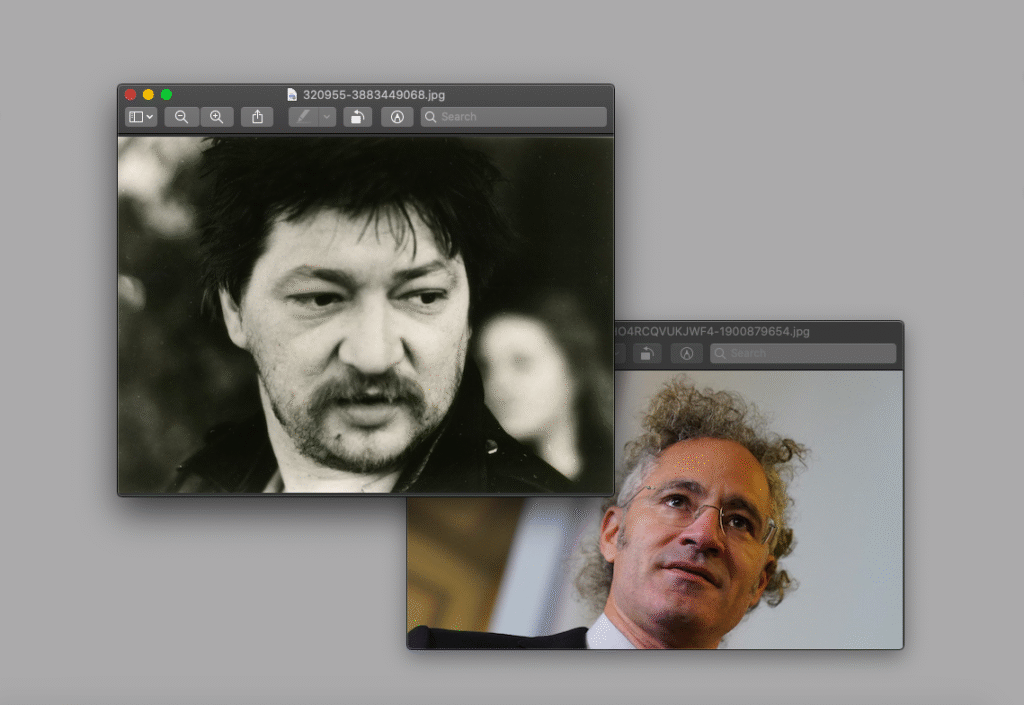
Starting from Fassbinder’s cinema and a minor academic omission, the text takes an unlikely detour to think about how power has shifted from scenes to prediction.
Alexander Karp, the co-founder and CEO of Palantir Technologies, belongs to a growing class of technological leaders whose influence over contemporary forms of power far exceeds their public visibility. Palantir’s data systems are used by police forces, intelligence agencies, and military institutions to anticipate crime, manage risk, and model future threats, often before they take material form.
Less well known is Karp’s academic background.
Before Silicon Valley, before defense contracts and data infrastructures, Karp studied philosophy and social theory in Germany. He spent years in Frankfurt, close to the academic environment shaped by Jürgen Habermas and critical theory. In 2002, he completed a doctoral dissertation titled Aggression in the Lifeworld, a dense sociological work engaging Talcott Parsons, Theodor Adorno, and, at an early stage, the cinema of Rainer Werner Fassbinder.
That detail is more than anecdotal.
At a moment when industrial and military technologies are increasingly developed by figures with deep humanistic training, Karp’s abandoned encounter with Fassbinder begins to look like a revealing fracture, a point where one understanding of power, violence, and images quietly gives way to another.
Fassbinder as a Test Case
For a brief moment, Rainer Werner Fassbinder seemed like the right object of study.
A central figure of the New German Cinema, Fassbinder dedicated much of his work to the close analysis of domination. His films return obsessively to marriages, families, and everyday rituals, spaces where power is exercised without spectacle but with devastating intensity. Martha (1974), the film Karp initially analyzed, is among his most severe works, a study of marital sadism, social complicity, and the violence sustained by silence.
If one wanted to understand how cruelty becomes normalized within bourgeois life, Fassbinder was an obvious choice.
And yet, Fassbinder disappears.
In the final version of Karp’s dissertation, Martha is explicitly abandoned as an empirical example. The justification is telling: the violence in Fassbinder’s film is too explicit, too overwhelming. It makes it difficult to focus on what truly interests Karp, not violence as an eruption, but the cultural mechanisms that allow aggression to be absorbed without open conflict.
What appears to be a minor academic decision signals a larger displacement.
Fassbinder’s cinema belongs to a world in which power still needs to appear.
His films are structured around scenes: confrontations, humiliations, breakdowns. Violence unfolds in time and space. It marks bodies and demands attention. Even figures of authority rule through instability, correcting and punishing because control is never fully secured.
Martha exemplifies this logic. Helmut’s domination is unmistakable, enacted through rules and prohibitions. The violence is domestic and intimate, but never invisible. It requires an image.
This is not a failure of Fassbinder’s cinema. It is its historical condition. It may also explain why Fassbinder initially appeared relevant to Karp: his films take forms of violence that remain socially private and force them into visibility, treating intimacy itself as a political site rather than a hidden one.
Fassbinder still trusts exposure. He believes that forcing violence into visibility can unsettle the spectator. His cinema presupposes confrontation as a political resource.
That assumption does not end with Fassbinder. It persists in later forms of prestige independent cinema that continue to rely on explicit cruelty as a critical gesture. What circulates in these images is not material deprivation, but ethical misery: scenes of moral degradation, abuse, and humiliation presented as evidence of seriousness. What changes is not the subject, but the function. Exposure hardens into a recognizable aesthetic, and ethical collapse becomes less a site of tension than a familiar visual currency.
The problem is not repetition as imitation, but repetition as stabilization. Violence continues to be shown because it is still assumed that showing is where critique happens, even as power increasingly organizes itself elsewhere.
This belief, however, becomes increasingly fragile.
What Karp Was Looking for Instead
Karp’s theoretical project moves in another direction.
Drawing on Parsons and Adorno, his dissertation is concerned with aggression that does not erupt, with forms of domination that integrate hostility into norms, language, and expectations. The question is not why violence happens, but how societies manage to function without it becoming visible.
In this framework, power is most effective when it does not need to appear as force. Decisions are anticipated. Compliance is internalized. Aggression is neutralized before it becomes an event.
From this perspective, Fassbinder becomes difficult to use, not because he is wrong, but because he shows too much.
His images belong to moments when power has already failed to remain invisible.
From Scenes to Systems
This shift is not only theoretical. It is visual.
Fassbinder works with rooms, faces, gestures. Palantir works with dashboards, correlations, and predictive models.
The difference is not simply aesthetic; it is temporal.
Fassbinder’s images belong to a world organized around aftermaths. Violence may be anticipated, but it must still take place before it can be shown. What his cinema renders visible are consequences, not probabilities.
Surveillance cameras operate retrospectively. They record what has already happened. Their images are forensic, bound to the aftermath of an event. Violence occurs first; the image follows.
Predictive systems invert this logic. They do not depend on cameras in the classical sense. They operate before events occur, replacing scenes with models and lived situations with simulations of risk. Their primary images are statistical: probabilities, patterns, risk scores. Violence is addressed not as an event to be documented, but as a scenario to be neutralized in advance.
In this regime, the image does not witness. It intervenes.
Power no longer waits for something to appear. It works by shaping conditions so that certain actions never take place, certain subjects never enter visibility, and certain futures quietly close.
Somewhere in that transition, some forms of cinema stop being a privileged diagnostic tool, not because images disappear, but because they no longer behave like images in the classical sense.
image: Femto predictive models