
Somewhere deep in YouTube, between forgotten clips, abandoned channels, and videos no one seems to return to, there’s a Chilean film uploaded more than a decade ago that barely reaches a thousand views. It’s called Mapamundi (2013), and it’s available in full with well-made English subtitles. It’s one of those quiet discoveries that feel oddly out of place amid the surrounding algorithmic noise.
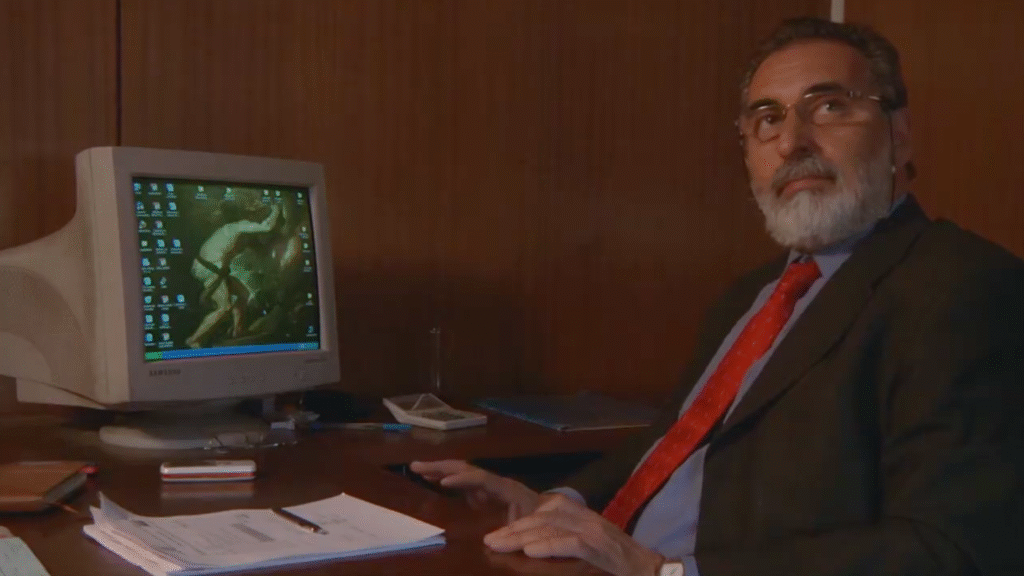
Directed by Javier Zoro, Mapamundi initially presents itself as an attempt to adapt a book written by a character named Joaquín, an obsessive map lover, slightly eccentric, and gently framed as a figure of minor failure. The director introduces him as a friend, and from the beginning the film adopts a tone of affectionate irony. Passages from Joaquín’s book are introduced by a solemn voice-over, “Joaquín wrote…”, a phrase that sounds almost biblical, as if announcing a sacred text. The effect is quietly comic: the words are elevated, only to be brought back down by the character himself.
At first, the film seems firmly anchored in cartography as subject matter. Mercator, medieval maps, distorted continents, even an old 8-bit video game where Joaquín delights in naming himself a cartographer and exploring imaginary worlds. Different formats, eras, and visual registers coexist fluidly, without hierarchy. But around the twenty-minute mark, Mapamundi opens up. The book stops being the center. A different film begins to emerge.
The question shifts from “What does Joaquín’s book say?” to “Where does Joaquín stand in the world?”
From there on, the documentary element slowly takes over. Joaquín lives with his father in a strange, improvised space above a car repair workshop. Below are manual labor, noise, discarded machine parts. Above are maps, archives, famous cartographers, and theories about how the world has been drawn and imagined. The film quietly establishes a vertical relationship between representation and material reality, between the map and what lies beneath it.
The workshop becomes a central landscape. Used car parts arrive from Europe, discarded by the market, then repaired and repurposed by workers, many of them migrants from different parts of Latin America. They talk about their jobs, about travel, about places they haven’t seen. There’s no explicit denunciation here, no heavy-handed critique. The film simply lets a global geography take shape: center and periphery, circulation and reuse, work and imagination.
In one of the film’s most elegant moments, as Joaquín’s book reflects on the antipodes, those places Europe historically struggled to imagine, the workshop appears upside down in the frame, as if it were literally below the world. “What kinds of monsters might live there?” the text wonders, while the image shows something far more ordinary and far more human.
What makes Mapamundi remarkable is not just what it addresses, but how it does so. It asks large questions about why we see the world the way we do, who gets to draw its maps, and where those images come from, without becoming solemn, academic, or didactic. The film moves lightly and playfully, with a sense of curiosity rather than authority. It’s genuinely enjoyable to watch.
Perhaps that’s part of why it has remained so quietly tucked away. Formal experimentation of this kind often travels easily when it comes from certain places, and much less so when it emerges from others. Mapamundi is a film about maps, but also about visibility. Who gets seen, and who remains off the chart.
More than ten years later, the film is still there, open and accessible, waiting to be discovered. It’s worth the time, not only for what it shows, but for the way it gently encourages us to look again at images, at worlds, and at the maps we’ve learned to trust.
The film is available in full below.