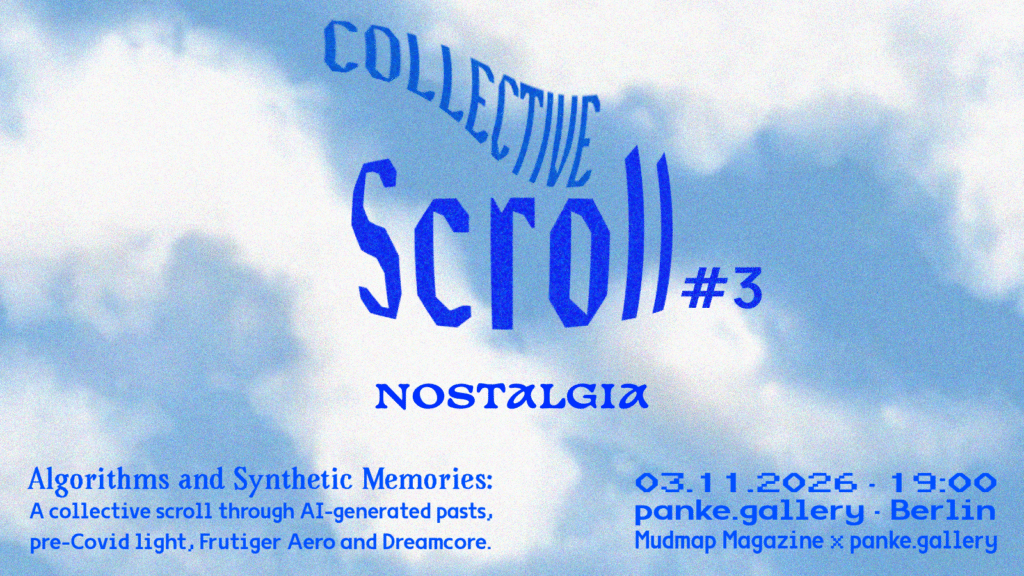
November 3, 2026 · 19:00
panke.gallery, Berlin
For its third edition, Collective Scroll comes to panke.gallery to explore nostalgia as an online image culture: how the past is remembered, idealised and increasingly generated.
Nostalgia is one of the most productive moods of the feed, and it keeps changing shape. This session follows that change through a sequence of aesthetics that each look back at a different past. Y2K and Frutiger Aero return to the glossy, optimistic interfaces of the early 2000s. Dreamcore turns half-remembered spaces into places no one has actually been. “Pre-Covid light” gathers people who remember the world before 2020 as brighter, warmer and more colourful. The scroll will move between them to see how each is named, tagged and recommended, and to trace a small evolution in what could be called the algorithm of nostalgia.
The session pays particular attention to the growing visual culture of AI-generated pasts: images of “Christmas 1995,” childhood bedrooms, family photographs, summer evenings in the 1980s or 1990s, and other scenes that feel immediately familiar despite having no specific event behind them. They present an imagined past in the visual language of memory. Of all these aesthetics, this one is the most interesting for two reasons. It is a literal fabrication of memory, with all the paradox that implies, and it is currently the most widespread form nostalgia takes online.
AI can generate the image one wishes existed: a plausible scene built from shared visual conventions, with no photograph behind it. Film grain, flash photography, domestic interiors, old cameras, colour palettes and styles of dress give these scenes the appearance of personal or archival memory. The session asks how these visual cues produce recognition, attachment and a feeling of historical truth.
The scroll will move through generated images, captions, prompts, accounts and comment sections to follow how these pasts are made and circulated. It will pay attention to recurring motifs, the kinds of homes, bodies and families that appear, and the versions of history these images make desirable.
Nostalgia can hold affection, loss, pleasure and curiosity. It can also be mobilised politically when an idealised past is presented as something that should be restored. In nationalist or anti-immigration discourse, this often means imagining a homogeneous past and framing social change as decline. The session will consider how generated images can take part in this by making particular fantasies of belonging visually persuasive.
The discussion will ask how nostalgia has changed form as platforms learned to recommend it, and what makes an invented image feel like a memory. It will ask what kinds of past become easier to imagine and share through AI, and what disappears from these scenes. It will also ask when longing for the past begins to make a claim about the present. These questions are an entry point, and the conversation is also meant to drift. The session leaves room for the tangents, associations and detours that no one planned, and follows them when they appear.
About Collective Scroll
Collective Scroll is a live format developed by Mudmap Magazine. Each session enters a specific corner of the internet and moves through it via images, accounts, comments, interfaces, hashtags and keywords as they appear in real time. The starting point can be a subculture, a visual trend, a conspiracy theory, an emerging aesthetic, an online community or a particular type of image.
Scrolling is usually individual, alienating and barely conscious. In Collective Scroll, a single feed is shared with the audience, and the images, recommendations and associations that are normally experienced in private become material for observation and conversation. This makes visible the structures that organise that experience: the rhythm at which images appear, their repetitions, the drift from one recommendation to the next, the classification systems of platforms and what remains out of frame.
The shared screen also changes the position of the spectator. The audience can propose searches, suggest routes, linger on an image, connect it to another or challenge a reading, so the session takes shape between the prior research, the behaviour of the platform and the people in the room.