
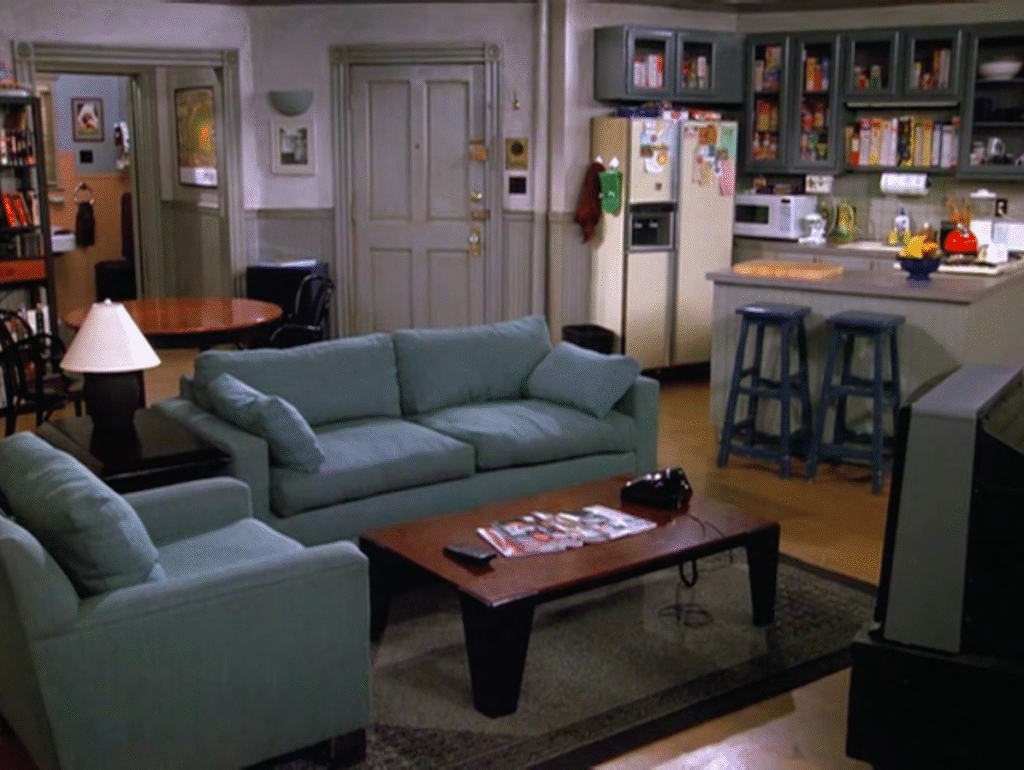
At first glance, Nothing appears to be a minimal gesture: a short video composed exclusively of shots from Seinfeld in which no characters are present. No dialogue, no action, no plot. Just façades, interiors, corridors, streets. What begins as a simple constraint slowly reveals itself as something more precise, and quietly unsettling.
Detached from their original context, these images stop functioning as establishing shots or narrative transitions. A restaurant façade, an empty grocery store, a residential building at night: removed from the rhythm of the sitcom, they could easily belong somewhere else. Some of these images, especially the exterior shots, would not feel out of place alongside the urban passages of Chantal Akerman’s News from Home. Without punchlines or timing, television architecture drifts toward a kind of cinematic stillness.
One of the most striking operations in Nothing is sonic. At first, the residual laughter and music remain stubbornly attached to the images. They behave like ghostly traces of the sitcom format, reminders that these spaces were once filled with bodies, jokes, and social friction. As the work unfolds, these sounds slowly fade. When silence finally takes over, the images begin to resemble photographs, distant and evocative, carrying a subtle sense of melancholy.
It is in the interior spaces that this estrangement becomes strongest. Jerry’s apartment and George’s office, sets made overly familiar through repetition, suddenly appear sterile and oddly lifeless. Without characters, these spaces no longer perform relatability. They become pure environments, carefully designed, lit, and maintained, waiting for a presence that never arrives. Television’s promise of intimacy collapses into architectural emptiness.
What Nothing ultimately exposes is not only the emptiness of a sitcom without people, but the infrastructure beneath serialized entertainment itself. By removing narrative and performance, Frezza allows the industrial image to show its underlying structure. These are not neutral spaces. They are environments built to host behavior, ideology, and repetition. Once emptied, they begin to speak in a different register.
The work shows how mass-produced images, endlessly circulated and overfamiliar, can be distilled into something else entirely. By pushing the image beyond entertainment and into absence, Frezza uncovers a strange surplus: a space for reflection, unease, and thought. Sometimes what lies beneath images is not another message, but a void. And that void, when carefully framed, becomes deeply political.